Abstract Canvas Art Styles Explained: Your Complete Guide
The Heva Team
Art Curators & Interior Design Enthusiasts · April 16, 2026 · 20 min read
There is a moment, standing in a room you love, when you realize the art on the walls is not just decoration. It is a language. It speaks before you do. Abstract canvas art has that power in abundance, because it does not tell you what to see. It invites you to feel something, to bring your own story to the surface, to let color and form do the talking that words sometimes cannot. Whether you are redecorating a living room, finishing a home office, or searching for the piece that finally makes a bedroom feel like a sanctuary, understanding abstract canvas art styles gives you the confidence to choose with intention rather than guesswork.
Ready to browse our abstract canvas collection? Shop abstract wall art now and find the style that speaks to your space.
Table of Contents
What Is Abstract Canvas Art?
Abstract canvas art is any artwork that moves away from realistic representation of the visible world and instead uses shapes, colors, forms, and gestural marks to achieve its effect. Rather than depicting a recognizable landscape or portrait, abstract art uses the visual elements themselves as the subject. The painting is not about something else. It is about color relationships, compositional tension, texture, and movement. It is a direct experience.
The roots of abstract art trace back to the early twentieth century, when artists began questioning whether painting needed to represent anything at all. Wassily Kandinsky, often credited as one of the first purely abstract painters, wrote extensively about the spiritual and emotional power of color and form divorced from representation. His 1911 paintings were unlike anything the Western art world had seen, and they opened a door that has never closed. Around the same time, movements like Cubism, Fauvism, and De Stijl were fracturing and rearranging the visual world in ways that pointed unmistakably toward abstraction.
By the 1940s and 1950s, Abstract Expressionism had taken hold in New York, with artists like Jackson Pollock, Mark Rothko, and Willem de Kooning producing work of staggering emotional intensity. These artists were not illustrating feelings. They were using paint as a direct channel for feeling. The results changed the history of art permanently. According to the Museum of Modern Art, abstraction remains one of the most influential movements in the entire Western art tradition.
Since then, abstract art has continued to evolve. Minimalism stripped everything back to essentials. Geometric abstraction brought mathematical precision to the canvas. Fluid art arrived with its mesmerizing poured layers. Today, abstract canvas art is the most popular art style for home interiors, precisely because its open-ended nature allows it to complement almost any design aesthetic. According to the Tate Gallery, abstract art encompasses a broad range of approaches united by their departure from direct visual representation.
For the home decorator, this richness means there is an abstract style for every personality, every room, and every intention. The challenge is knowing which style to choose and why. That is exactly what this guide addresses.
The 5 Major Abstract Art Styles
While the world of abstract art is vast and beautifully tangled, five broad styles have proven most beloved for home interiors. Each has a distinct visual character and emotional register. Understanding these helps you shop with confidence and hang with conviction.
Abstract Expressionism
Abstract Expressionism is the style most people picture when they hear the word "abstract." It is characterized by bold, energetic brushwork, expressive mark-making, and a sense that the artist's emotion has been transferred directly onto the canvas. Colors are often vivid and contrasting. Forms are organic rather than geometric. The overall feeling is dynamic, alive, and unapologetically human.
In a home interior, abstract expressionist pieces work best as statement art. They are not background pieces. They demand attention and generate conversation. A large-scale expressionist canvas above a sofa creates an immediate focal point. The best color choices depend on your existing palette. If your room uses neutral tones like cream, warm gray, or taupe, an expressionist piece in deep cobalt, burnt orange, or forest green will create a powerful accent. If your room already has strong color, look for expressionist work that shares those hues without repeating them exactly.
Abstract expressionism is also highly personal. Because it is so clearly the product of an individual's emotional state, it tends to resonate deeply with viewers who connect to its specific energy. When you find an expressionist piece that genuinely moves you, you will know immediately. That gut reaction is the whole point.
This style is particularly well suited for living rooms, studios, and dining rooms where you want an atmosphere of warmth, vitality, and creative energy. It pairs beautifully with mid-century modern furniture, eclectic interiors, and spaces that celebrate individuality over conformity.
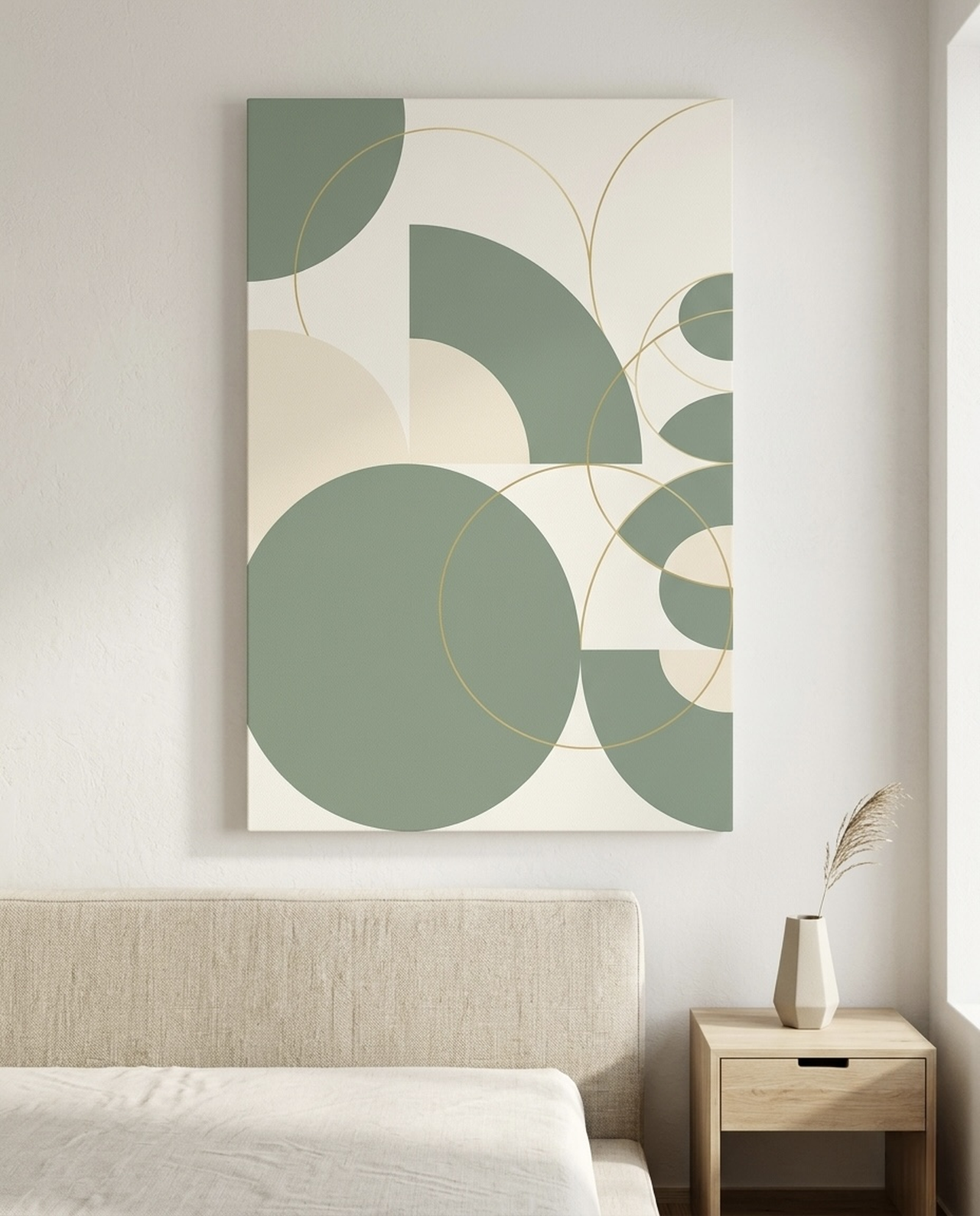
Geometric Abstraction
Geometric abstraction replaces the organic spontaneity of expressionism with precision, structure, and intentional form. Circles, squares, triangles, lines, and grids become the vocabulary. Color is often flat rather than blended, used in bold, defined zones. The result is art that feels confident, contemporary, and visually grounding.
This style has its roots in early twentieth-century movements like De Stijl, represented by Piet Mondrian's famous grid paintings, and Bauhaus, which applied geometric principles to design and craft. These movements believed that pure geometric form had a universal emotional language, that horizontal lines suggested calm, vertical lines energy, and the balance of opposites created harmony.
In the home, geometric abstract art works in almost any space because its clean lines and defined shapes are inherently orderly. It particularly complements minimalist interiors, Scandinavian design, industrial spaces, and modern apartments. A geometric canvas in a home office promotes focus and clarity. In a bedroom, soft geometric patterns in muted tones create a sense of structured calm. In a living room, a bold geometric statement piece anchors the space with visual authority.
Geometric abstraction also photographs particularly well, which makes it a popular choice for design-conscious homeowners who take pride in their interior styling. These are the pieces that look stunning in professionally staged photos, and even more stunning in daily life.
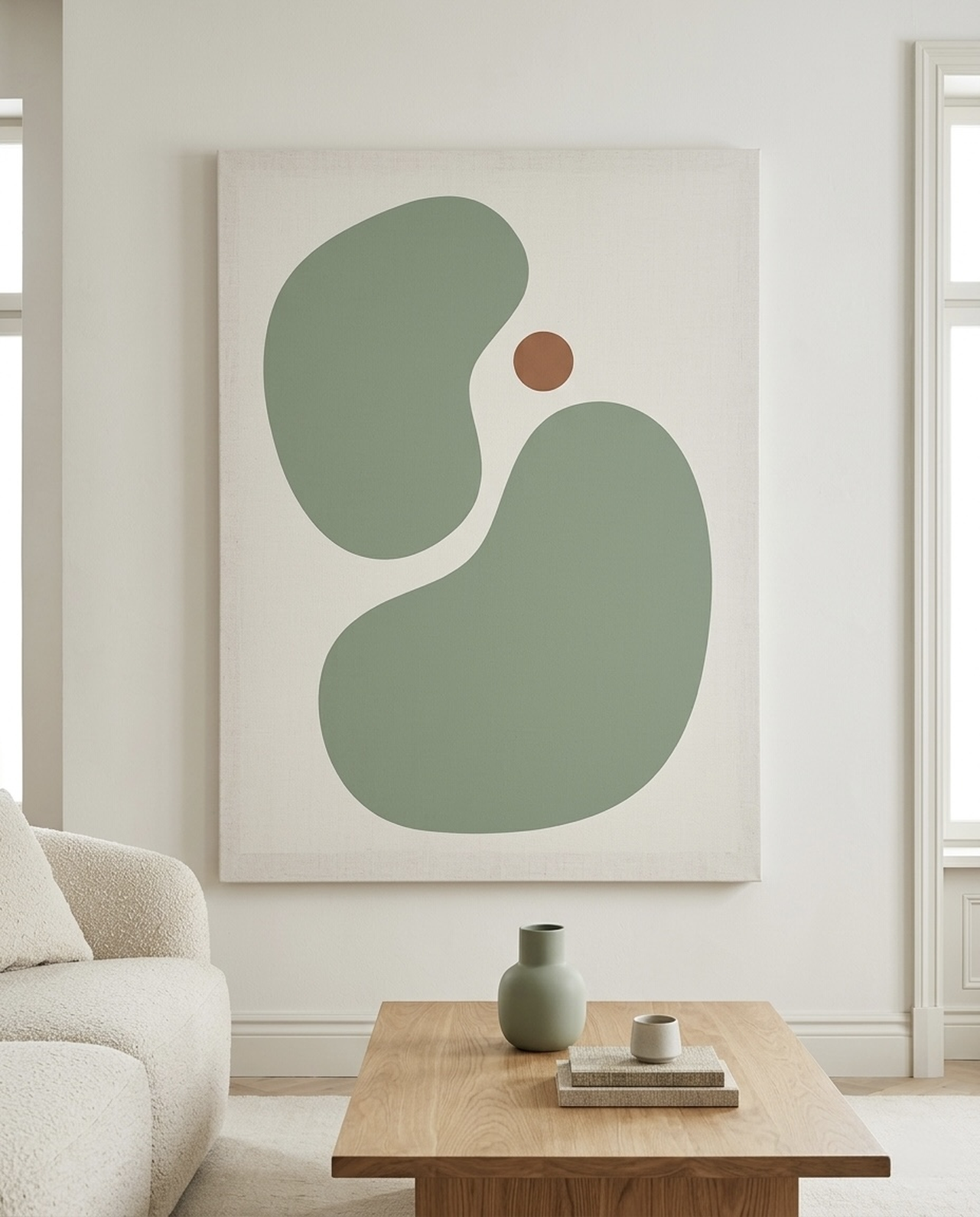
Minimalism
Minimalist abstract art operates on the principle that less is always more. A single line. A wash of one color. An almost-empty canvas with a subtle gradient. Negative space is not empty. It is active, loaded with quiet intention. Minimalist art asks you to slow down, to notice what is there rather than what is not, to find meaning in restraint.
In a culture that is constantly saturated with information and stimulation, minimalist art offers something genuinely rare: a place for the eye to rest and the mind to breathe. This is why it has become so beloved in home interiors over the past decade. A minimalist canvas in a bedroom signals that this is a space for recovery and renewal. In a living room, it says that you have edited carefully, that every object has earned its place.
Minimalism pairs effortlessly with neutral color palettes, natural materials like linen, oak, and stone, and interiors that value quality over quantity. The best minimalist pieces tend to have a single strong element, whether that is an exquisite line, a perfectly calibrated tone, or a composition so simple it borders on daring.
Fluid and Pour Art
Fluid art, sometimes called pour art or acrylic pour painting, is one of the most visually distinctive abstract styles. It is created by pouring or manipulating liquid acrylic paint across a canvas, allowing gravity, movement, and the paint's own viscosity to determine the final form. The results are characterized by flowing, organic patterns, cell-like formations, and color interactions that feel simultaneously natural and otherworldly.
The appeal of fluid art is immediate and almost universal. There is something deeply satisfying about its forms. They echo the patterns found in marble, agate, oceanic waves, and microscopic biological structures. Viewers often describe fluid art as mesmerizing, as something they could look at for long periods without tiring. This makes it an excellent choice for spaces where you spend significant time, like living rooms, bedrooms, and bathrooms.
Fluid art tends to work best in rooms with a natural or organic aesthetic. It complements boho interiors, coastal design, and spaces that celebrate texture and movement. Because the colors in fluid art are often rich and complex, you can pull from them to inform your broader color palette. Many decorators choose a fluid art piece first and then build the room's soft furnishings and accessories around the colors in the canvas.
Scale matters significantly with fluid art. A small piece loses much of its impact. To truly appreciate the flowing movement and cellular detail, opt for a canvas that is at least 20 x 24 inches (51 x 61 cm), and consider going much larger for open walls in living spaces.
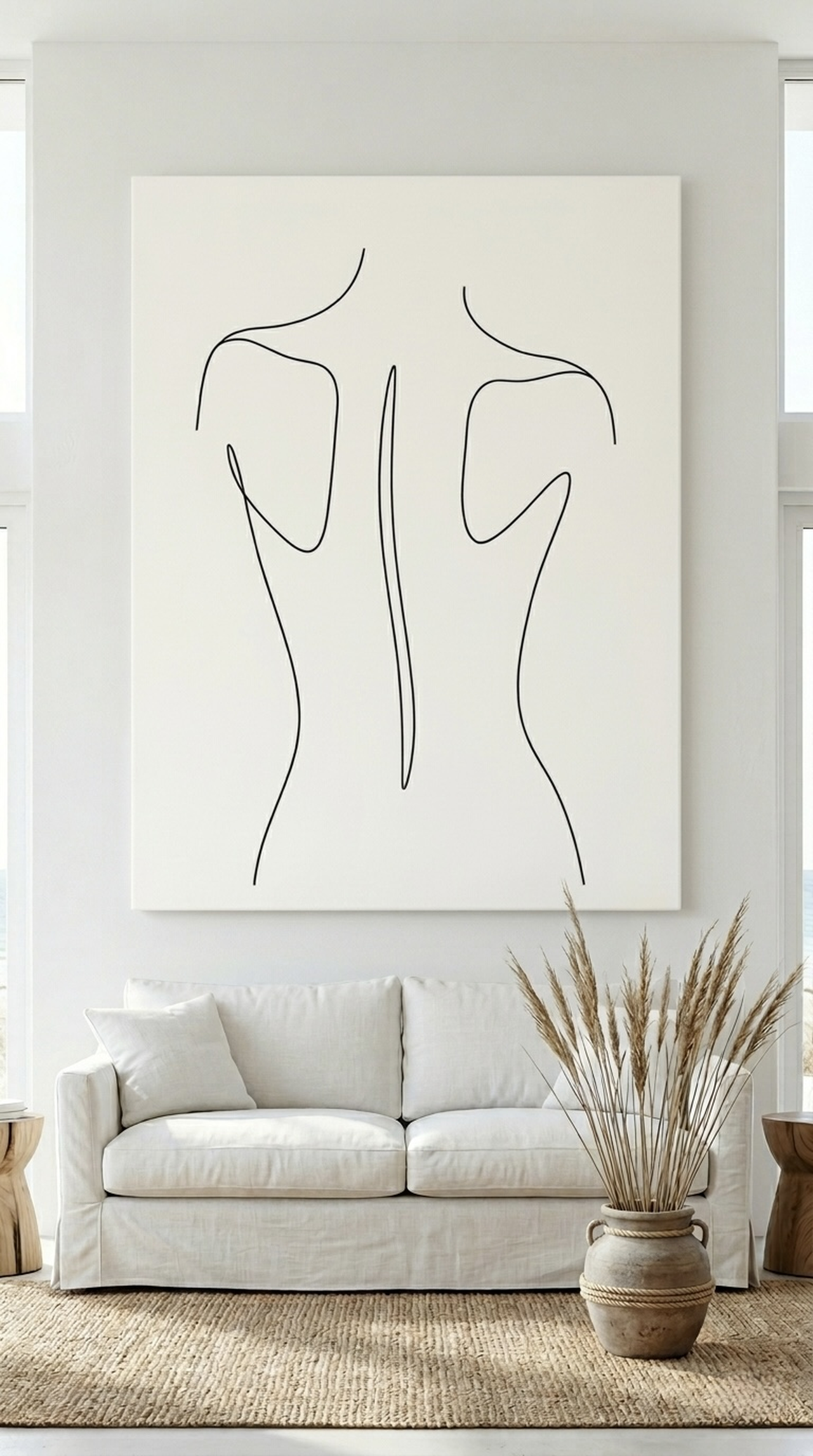
Calligraphy and Line Art
Calligraphy and line art represent the most intimate of the abstract styles. Using single continuous lines, brush script, or minimal mark-making, these works capture gesture, grace, and the beauty of the human hand in motion. A single brushstroke portrait. A word rendered in sweeping ink. A female figure reduced to one unbroken line. These pieces carry enormous emotional weight in the quietest possible visual language.
The tradition of calligraphy as an art form is ancient, with deep roots in East Asian culture where the quality of a brushstroke was understood to reveal the artist's inner state. Contemporary line art builds on this tradition, using the same principles of mindful mark-making to create pieces that feel both timeless and entirely modern.
In home interiors, calligraphy and line art work beautifully in bedrooms, bathrooms, nurseries, and any space where you want art that feels personal and considered rather than decorative. A meaningful quote in elegant script above a bed creates an intimate, grounding atmosphere. A minimalist figure in flowing ink above a dresser brings presence without visual weight.
These pieces are also particularly versatile in terms of framing. A simple black frame elevates line art into something gallery-worthy. A natural wood frame softens the composition. An espresso frame adds warmth. The simplicity of the art itself means it accepts almost any framing choice gracefully.

Choosing the Right Style for Your Room
Knowing the five major abstract art styles is only the beginning. The real skill is matching a style to a specific room, its function, its existing aesthetic, and the emotional atmosphere you want it to carry. Here is a room-by-room guide to help you choose confidently.
Living Room
The living room is the social heart of a home. It is where you welcome guests, gather with family, and unwind at the end of the day. Abstract art in the living room needs to work across all these registers, generating energy without being exhausting, creating visual interest without being chaotic.
Abstract expressionism and geometric abstraction are both excellent choices here. An expressionist canvas brings warmth and vitality, especially above a sofa where it anchors the seating arrangement. Geometric pieces communicate sophistication and intentionality. For living rooms with high ceilings, consider a large-format canvas, 36 x 48 inches (91 x 122 cm) or larger, to fill the vertical space appropriately.
Color is your most important decision. If your sofa and rug are neutral, use the art to introduce your accent color. If your room already has bold soft furnishings, look for abstract art that pulls those colors together in a new composition. The art does not need to match the room exactly. It needs to belong to the same conversation.
Bedroom
The bedroom is a private retreat. Art here should promote rest, reflection, and intimacy rather than stimulation. Minimalist abstraction, fluid art in soft palettes, and calligraphy and line art all work exceptionally well in bedrooms. These styles have a quieter visual energy that supports sleep and relaxation rather than interrupting it.
Color choice matters enormously in bedrooms. Deep, saturated hues can feel heavy unless balanced by significant negative space. Muted tones, sage greens, dusty roses, warm whites, and soft blues are consistently popular for bedroom abstract art because they create a sense of atmospheric calm. Pair a piece in these tones with natural linen bedding and warm wood furniture for a bedroom that feels genuinely restorative.
Scale in the bedroom can go either way. A large canvas above the headboard makes a dramatic focal point. A pair of medium canvases flanking the window creates a more intimate, gallery-like arrangement. Both approaches work. The choice depends on how prominently you want the art to feature in your daily experience of the space.
Home Office
A home office is a workspace, and art here should support concentration, creativity, or both depending on the work you do. Geometric abstraction and minimalism are the most popular choices for home offices. Their precision and restraint create visual environments that encourage focus without distraction.
If your work is creative in nature, writing, design, music, or art, then a more expressive abstract piece can serve as a source of inspiration and energy. Position it somewhere you can glance at during thinking pauses. If your work requires sustained analytical concentration, lean toward minimalist pieces or clean geometric compositions in cool tones. Blues and greens have been consistently shown to support focused mental states.
Avoid very large-scale or very high-contrast pieces directly in your line of sight at a desk. They can become visually tiring over long work sessions. Instead, place bold statement art on a perpendicular wall that you see when you look up and away from your screen.
Kitchen and Dining
The kitchen and dining room are spaces for appetite, conversation, and the pleasure of gathering. Abstract art here works best when it contributes to a feeling of warmth and invitation. Fluid art in warm tones, geometric abstractions with earthy colors, or botanical-inspired abstract pieces all carry the right energy for these rooms.
Scale needs to be considered carefully in kitchen spaces. Art near cooking areas should be framed under glass or be a canvas print that can tolerate occasional moisture and grease. Keep art well away from direct heat sources. In dining rooms, a single large canvas centered on the primary wall creates a beautiful backdrop for the table and gives the room a sense of occasion.
Placement Guide with Measurements
Even the most perfectly chosen abstract canvas can underperform if it is hung incorrectly. Placement is a skill, and like all skills it becomes intuitive once you understand a handful of core principles.
The Eye-Level Rule
The universal starting point for hanging any artwork is the eye-level rule. The center of the canvas should sit at eye level, which in practice means approximately 57 to 60 inches (145 to 152 cm) from the floor to the center of the piece. This is the standard used by most professional galleries and museums, and for good reason. It positions art in the zone where the human eye naturally settles when scanning a room.
A common mistake is hanging art too high, particularly in rooms with tall ceilings. The impulse to fill vertical space by pushing art upward creates a disconnected, floaty feeling. Anchor the art at eye level and let the wall breathe above it.
Art Above Furniture
When hanging a canvas above furniture, such as a sofa, console table, bed, or desk, maintain 6 to 8 inches (15 to 20 cm) between the top of the furniture and the bottom edge of the canvas. This gap creates a visual connection between the art and the furniture without making the piece look like it is about to fall onto the surface below.
For sofas and beds, the canvas width should be approximately 55 to 75 percent of the furniture's width. For a standard 84-inch (213 cm) sofa, this means a canvas or arrangement between 46 and 63 inches (117 to 160 cm) wide. This proportion keeps the art from looking too small and inconsequential, which is the single most common decorating mistake.
Size Guide by Room
Here are practical size recommendations by room type:
- Living room above sofa: 40 x 30 inches (102 x 76 cm) minimum. For rooms with 9-foot (274 cm) or higher ceilings, 48 x 36 inches (122 x 91 cm) or larger is ideal.
- Bedroom above headboard: Match or slightly exceed the headboard width. For a queen bed with a 60-inch (152 cm) headboard, aim for 54 to 60 inches (137 to 152 cm) wide.
- Home office accent wall: 24 x 30 inches (61 x 76 cm) to 30 x 40 inches (76 x 102 cm) for focused, personal spaces.
- Hallway or entryway: 16 x 20 inches (41 x 51 cm) to 20 x 24 inches (51 x 61 cm) works well in narrower spaces.
- Dining room statement wall: 36 x 48 inches (91 x 122 cm) or larger for a room that can accommodate it.
Gallery Wall Arrangements
When creating a gallery wall with multiple abstract pieces, the key is consistency in spacing. Maintain 2 to 3 inches (5 to 8 cm) between frames throughout the arrangement. Map the arrangement on the floor before committing to the wall. The outer edges of the gallery wall should align with the furniture below it, maintaining the same width proportions as a single large canvas would.
For abstract art gallery walls, create cohesion either through a shared color palette or through consistent frame treatment, matching all frames in finish, or deliberately mixing in a controlled way. Three to five pieces is the sweet spot for most residential gallery walls. More than seven pieces can begin to feel cluttered.
5 Common Mistakes When Choosing Abstract Canvas Art
Even people with strong aesthetic instincts fall into these traps. Knowing them in advance saves time, money, and redecorating regret.
Mistake 1: Choosing Art That Is Too Small
This is the most prevalent decorating mistake in home interiors. A canvas that is the right choice in every other way fails to deliver its potential simply because it is undersized for the wall. A piece that would be stunning at 30 x 40 inches (76 x 102 cm) becomes forgettable at 16 x 20 inches (41 x 51 cm). Before purchasing, tape paper to the wall in the intended dimensions and live with it for a day. You will almost always discover that you want to go bigger.
Mistake 2: Ignoring Undertones
Abstract art that looks perfect in isolation can clash unexpectedly in your room because of undertone conflicts. A canvas with cool blue-green tones will fight against a room's warm cream walls and honey-oak furniture. Train yourself to look at undertones, the subtle warm or cool bias that underlies every color, and choose art whose undertones harmonize with your existing palette.
Mistake 3: Matching Too Exactly
The opposite of the undertone problem is matching too precisely, choosing a canvas simply because it contains the exact same colors as your sofa cushions. Art that matches too exactly looks like an accessory rather than a statement. The goal is harmony, not repetition. The art should share the room's color language while adding something new to the conversation.
Mistake 4: Ignoring Room Scale
A small canvas in a large room will always look tentative and unconvincing, regardless of how beautiful the piece is. Similarly, an overwhelming canvas in a small room can create visual claustrophobia. Always consider the total wall space, the ceiling height, and the scale of the furniture when choosing your canvas dimensions. The art needs to be in proportion with its environment to achieve its full impact.
Mistake 5: Letting Trends Override Personal Connection
Trends in abstract art styles for home interiors shift regularly, as they do in fashion and product design. What is everywhere in design publications one year may feel dated three years later. The art that stands the test of time in your home is the art you genuinely connect with emotionally. If a piece makes you feel something real, it will continue to reward you for years. If you chose it because it was trending, you may find yourself restless with it sooner than you expect. Buy what you love, not what is popular.
Frequently Asked Questions
What is the most popular abstract canvas art style for home decor?
Minimalist and geometric abstract styles are currently the most popular for home decor, prized for their versatility and ability to complement modern interiors without overwhelming the space. Fluid art and line art are also consistently strong performers, particularly in bedrooms and personal spaces where a softer, more organic quality is desired.
How do I choose the right size abstract canvas for my wall?
A canvas should fill approximately 55 to 75 percent of the wall width above the furniture it relates to. For a standard 60-inch (152 cm) sofa, aim for a canvas between 33 and 45 inches (84 to 114 cm) wide. Always go larger rather than smaller when in doubt. A piece that is slightly large for a wall reads as confident and intentional. A piece that is too small reads as an afterthought.
Can I mix different abstract art styles in the same room?
Yes, mixing abstract styles works beautifully when you maintain a consistent color palette across the pieces. Pair geometric work with fluid art using the same 2 to 3 colors for cohesion. You can also use consistent framing, such as all black frames or all natural wood frames, to unify pieces from different style families. The key is establishing a visual thread that connects the works without making them look like a matching set.
What colors work best for abstract canvas art in a small space?
Light, muted tones like sage green, warm white, soft blush, and dusty blue expand a small space visually by keeping the walls from feeling closed in. In rooms under approximately 150 square feet (14 square meters), avoid very dark or heavily saturated canvases on small walls. If you love bold color, introduce it in a single accent piece on the largest wall in the room, where it becomes a feature rather than an overwhelming presence.
Is abstract canvas art suitable for a minimalist home?
Absolutely. Minimalist abstract art, line art, and single-color or limited-palette geometric pieces are ideal for minimalist interiors. In a minimalist home, one carefully chosen statement canvas carries far more visual impact than a gallery wall of smaller pieces. Choose art with significant negative space, a restrained palette, and clean edges. The canvas becomes a deliberate, powerful element in the composition of the room rather than decoration added over the top of it.
How do I hang abstract canvas art at the correct height?
Hang the center of the canvas at approximately 57 to 60 inches (145 to 152 cm) from the floor. This corresponds to average eye level and is the standard used by professional galleries. When hanging above furniture, leave 6 to 8 inches (15 to 20 cm) of space between the top of the furniture and the bottom edge of the canvas. This gap visually connects the art to the furniture while keeping the composition light and airy. In rooms where people are primarily seated, such as dining rooms, you may lower the hanging point slightly so the art reads at seated eye level.
Quick Reference: Abstract Art Styles at a Glance
| Style | Best Room | Key Features | Mood | Perfect For |
|---|---|---|---|---|
| Abstract Expressionism | Living room, dining room | Bold brushwork, vivid color, gestural marks | Dynamic, energetic, emotional | Statement walls, spaces that celebrate personality |
| Geometric Abstraction | Home office, living room | Precise shapes, flat color, structured composition | Confident, contemporary, grounding | Minimalist interiors, modern apartments |
| Minimalism | Bedroom, bathroom | Negative space, restrained palette, single focal element | Calm, refined, intentional | Restorative spaces, Scandinavian and Japanese-inspired design |
| Fluid and Pour Art | Living room, bedroom | Organic flow, cellular patterns, layered color | Mesmerizing, organic, luxurious | Boho interiors, coastal design, spaces with natural materials |
| Calligraphy and Line Art | Bedroom, nursery, entryway | Single continuous line, brush marks, elegant script | Intimate, graceful, personal | Meaningful spaces, gifts, rooms that tell a personal story |
The world of abstract canvas art styles is genuinely rich and rewarding to explore. Each movement and approach carries its own history, its own emotional register, and its own relationship to the spaces it inhabits. A confident, well-chosen abstract canvas does not just decorate a room. It completes it. It becomes part of the rhythm of daily life, something you see every morning and every evening, something that quietly shapes how you feel in the space where you live most fully.
Every wall tells a story. Whether you are drawn to the bold energy of expressionism or the quiet confidence of minimalism, the right abstract canvas art transforms a house into a home that feels unmistakably yours. The five styles covered in this guide are not just categories. They are entry points into a visual language that has the power to change how you feel in your own space every single day.
Explore our full abstract canvas collection and discover the style that resonates with you. Free shipping on all orders.